
AI & Innovation Lab

Why AI Programmes Stall
Pilots that produce impressive demos but no clear route to production.
AI tools built by external teams that the internal team cannot explain or maintain.
Spend that grows without clear evidence of what is working.
Governance and explainability treated as an afterthought, not a foundation.
How we deliver

We deliver using the combined strength of four disciplines. These capabilities operate as integrated teams delivering outcomes while building internal delivery capability across the organisation.
With Zero Dependency, and without it
With Zero Dependency®
Without it
Delivery Includes

A clear hypothesis and success criteria agreed before any work begins.
AI use cases prioritised by measurable service outcomes.
Pipelines, prompts, models and evaluation frameworks built in your repositories.
Lightweight safety reviews covering privacy, bias and security.
Clear decision sessions comparing the current service with the improved AI-enabled journey.
The outcomes
this drives
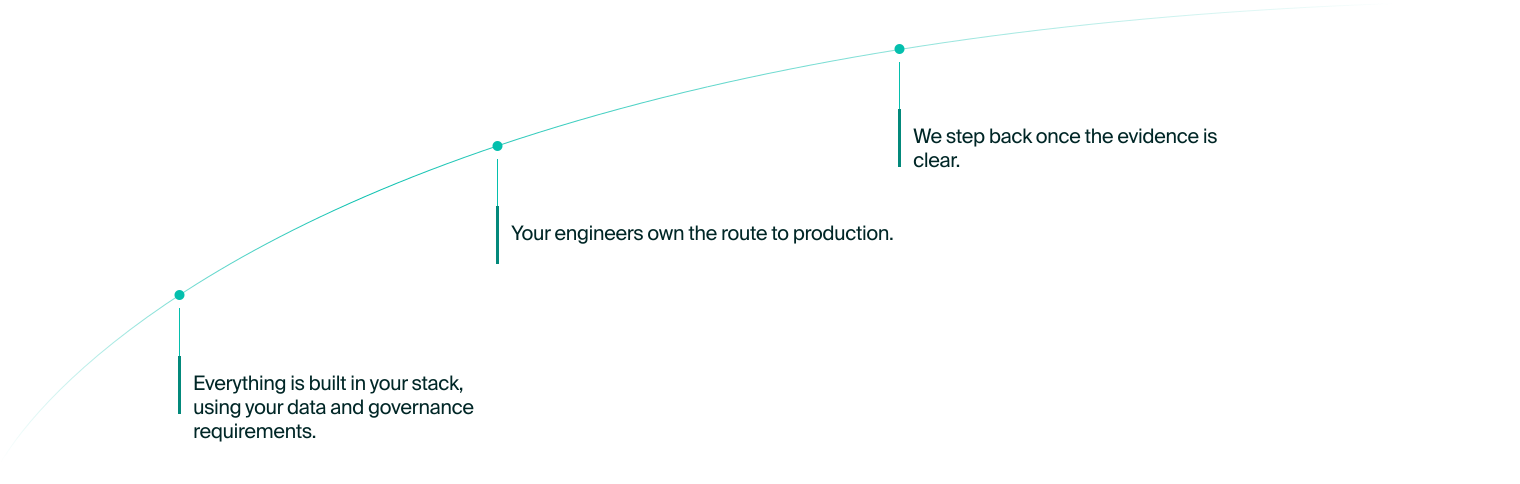











Zero Dependency®, by design
We qualify the engagement, shape scope, and agree commercials. The groundwork before delivery starts.

Common Questions
How do you approach AI adoption?
We apply AI where it creates measurable value, not where it is fashionable. Every initiative starts with a clear hypothesis and defined success criteria. Responsible AI practice, governance, explainability, safety, is built into every cycle from the start, not reviewed at the end.
What happens at the end of each innovation cycle?
Each cycle ends with a clear go or no-go decision based on the evidence gathered. If the idea has proven value, we define a route to production your engineers can own. If it has not, the organisation has learned something useful without committing further investment.
How does this reduce the risk of AI adoption?
By structuring every initiative around evidence rather than enthusiasm. Hypotheses are defined before work begins, success criteria are agreed in advance, governance and explainability are built in, and each cycle ends with a decision rather than an assumption that it worked.
Deep in the sectors
we know best.